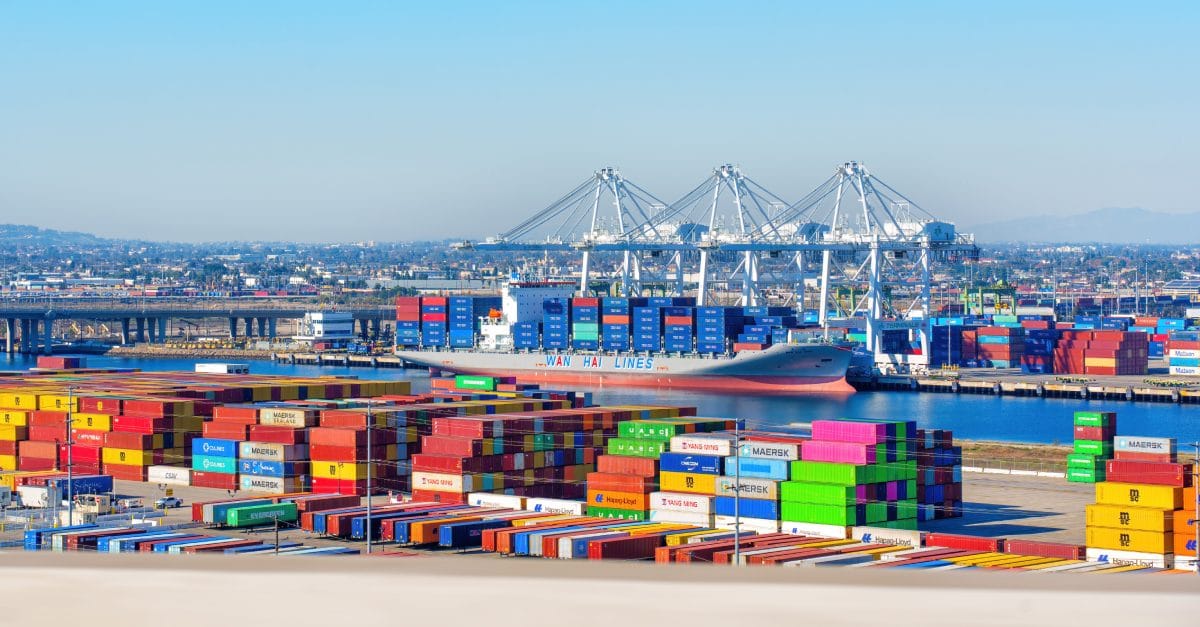
Freight just got its biggest deal in years and its clearest rate signal in a long time, in the same month. C.H. Robinson has agreed to acquire RXO in a $5.8 billion deal that would reshape truck brokerage, while September data shows truckload linehaul rates up another 10% and forecasters warning that contract pricing set this fall will carry straight into 2027. On the reefer side, rates keep climbing even as freight cools.
Read on to understand the state of the freight market and what shippers should factor into their next round of bids.
Truckload Linehaul Rates Rise 10% as Shipments Stay Positive
Cass Information Systems’ Truckload Linehaul Index rose 10.1% year over year in September and 0.6% from August, the highest absolute reading in four years and the 21st straight month of annual growth.
Cass noted that “even as spot rates slow with modest sequential declines, the much larger contract market is still adjusting higher.” Demand is helping as freight shipments rose 1.9% year over year, the second consecutive annual increase after 42 months of declines. Cass pointed to modest retail and industrial growth and restocking tied to surging container imports, and forecasts shipments up 4% year over year in October.
That turn in volumes has been building for months. Back in June, we noted that freight volumes were nearing a turning point as retailers pulled imports forward, and the restocking Cass describes now looks like the follow-through. The cost side is steeper, with expenditures, including fuel, up 20.4% year over year, and diesel up 68%, and Cass expects spending to climb about 23% in October.
C.H. Robinson Agrees to Buy RXO in $5.8 Billion Deal
C.H. Robinson announced a cash-and-stock deal to acquire RXO, creating a combined company with an enterprise value above $25 billion. RXO shareholders would receive $17.25 in cash plus 0.0856 C.H. Robinson shares per share, an implied $30.25 and a 29% premium to RXO’s October 2 closing price. Final consideration will be prorated to roughly 57% cash and 43% stock, leaving RXO holders with about 11% of the combined company.
The case rests on cost. C.H. Robinson expects about $300 million in net run-rate cost synergies within two years of closing, driven by its lean AI operating model, consolidated shared services, lower cost to serve, and moving RXO onto its existing vendors. RXO will be folded mainly into C.H. Robinson’s North American Surface Transportation division. Closing is expected in the first half of 2027, pending regulatory approval and an RXO stockholder vote.
CEO Dave Bozeman called it “a natural next step in our transformation.” Open questions remain on integration and on regulatory scrutiny, since shippers and carriers may worry about pricing power and options in truck brokerage.
Reefer Rates Climb Even as Freight Cools
DAT’s reefer report for the week ending October 10 shows the same capacity-over-demand pattern. National reefer spot linehaul averaged $2.75 per mile, up 2.1% week over week and 32.7% year over year, about 27.6% above the nine-year seasonal average of $2.15. Load posts fell 20.7% as end-of-quarter freight cleared, while truck posts rose 2.4%, pulling the load-to-truck ratio down to 16.75 from 21.65 two weeks earlier. That is still 56.5% above the 10.71 recorded a year ago.
Regional strength was concentrated in the Midwest. The Upper Midwest posted the strongest weekly gain at $3.51 per mile, while the Great Lakes ($3.41) and Ohio River ($3.30) also stayed well above the national average. Reefer rates rose even as freight cooled, pointing to capacity rather than demand as the driver. DAT’s 35-day forecast projects spot linehaul at $2.77 per mile, with a 70% confidence band of $2.68 to $2.86, the widest of the three equipment types and a sign of more uncertainty for temperature-controlled shippers.
Forecasters Warn Higher Rates Will Carry Into 2027
Early October data show contract truckload rates at $2.72 per mile excluding fuel, up 18% from a year earlier and at a 52-week high, according to FreightWaves SONAR figures. Spot rates, measured by the National Truckload Index, rose nearly 50% over the same period. The pressure behind that outlook isn’t new. In July, we looked at how trucking costs were rising faster than inflation as capacity cuts pushed freight rates higher, and the fall data shows those effects flowing into contract pricing.
The unusual spot-versus-contract relationship seen earlier in 2026 had largely corrected by Q4, with pricing power shifting toward carriers. Its central scenario projects truckload linehaul costs rising 5% to 8% in 2027, 2% to 5% if demand weakens, and 8% to 12% or more if capacity tightens sharply. Annualizing late-2026 contract pricing alone could add roughly 4% to 5% in inflation versus the 2026 average, before any fuel changes.
Washington’s Industry Policy Is Getting a Makeover
While the Biden administration leaned on federal investment, grants, and tax incentives, the Trump administration seems to rely more on tariffs and sector-specific deals. The Information Technology and Innovation Foundation’s Stephen Ezell describes today’s approach as “ad hoc, sector-specific interventionist,” with tools including a roughly 10% government stake in Intel, Nvidia sharing 15% of revenue from certain chip sales to China, and a golden share in the Nippon Steel acquisition of U.S. Steel.
Opinions on results differ. Alex Krutz, a former Commerce Department official, argues the government should shape demand and signal that it will last, since factories take years to build. University of New Haven’s Paul Lavoie questions whether tariffs count as industrial policy at all, since they add cost without directly funding capacity.
For shippers, the practical read is that policy affects the land sector by sector, and tariffs have already raised costs for industries dependent on global supply chains.
Shippers Need Freight Clarity in Such Volatile Times
Consolidation in brokerage, 10% linehaul increases, and forecasts pointing to another year of rate pressure all point to the same thing — leverage is shifting toward carriers, and the cost of waiting is rising. Shippers heading into the 2027 bid season should budget for contract rates that start higher than this year’s average, closely track tender acceptance, and keep intermodal and alternative sourcing options ready.
Speak to one of Zengistics’ experts to build a freight strategy that holds up under a tightening, higher-cost market. Connect with us today.